
Server Virtualization - Why You Should Use It and the Best Software Solutions
One of the most important reasons for Server Virtualization in IT organizations is the wish for better utilization. Servers of the current generation often only use 10-20% of their capacity. Nevertheless, in many industries, it is necessary to keep certain applications separate from each other. This also makes it easier to monitor and manage server resources.

Here you'll find Server Virtualization


- 4U Rack Server, up to 165W TDP with IVR
- 8x Hot-pluggable nodes
- Dual Socket P, 2nd Gen Intel Xeon Scalable CPU
- 12x DIMM slots, up to 3TB RAM DDR4-2933MHz
- 2x or 4x Fixed 2.5SATA3/NVMe drive bays
- 2x PCI-E 3.0 x16 (low profile & SIOM), 1x PCI-E 3.0 x8 slots
- 4x 2200W Redundant power supplies (Titanium Level)

- 4U Rackmount Server, up to 165W TDP
- Dual Socket P, 2nd Gen Intel Xeon Scalable Processors
- 12x DIMM slots, up to 3TB RAM DDR4-2933MHz ECC
- 8x Hot-pluggable nodes
- 2x 3.5 SATA3 drive bays
- 2x PCI-E 3.0 x16 and 1x PCI-E 3.0 x8 slots
- 4x 2200W redundant power supplies (Titanium Level)

- 4U Rackmount Server, up to 300W cTDP
- Dual Socket SP5, AMD EPYC™ 9004 Series CPU
- 24x DIMM slots, up to 6TB RAM DDR5-4800MHz
- Dual ROM Architecture, 5nm technology
- 2x 10GbE RJ45 LAN ports
- 8x PCI-E Gen5 FHFL Expansion slots + 2x FHFL GPUs
- 4x 3000W redundant power supplies (Titanium Level)

special highlight
Liquid cooling solution
- 2U Rackmount Server, 4 Nodes
- Dual Socket E, 4th Gen Intel Xeon Scalable CPU
- 16x DIMM slots, up to 4TB RAM DDR5-4800MHz
- 2x 2.5 Inch hot-swap drive bays
- 1x VGA, 2x USB 3.2, 1x RJ45 MLAN
- 1x PCI-E 5.0 x16 slot, 1x OCP 3.0
- 2x 2600W redundant Power Supplies (Titanium Level)

special highlight
Liquid cooling solution
- 2U Rackmount Server, 4 Nodes
- Dual Socket E, 4th Gen Intel Xeon Scalable CPU
- 16x DIMM slots, up to 4TB RAM DDR5-4800MHz
- 6x 2.5 Inch hot-swap drive bays
- 1x VGA, 2x USB 3.2, 1x RJ45 MLAN
- 1x PCI-E 5.0 x16 slot, 1x OCP 3.0 slot
- 2x 2600W redundant Power Supplies (Titanium Level)

special highlight
Liquid cooling solution
- 2U Rackmount Server, 4 Nodes
- Dual Socket E, 4th Gen Intel Xeon Scalable CPU
- 16x DIMM slots, up to 4TB RAM DDR5-4800MHz
- 6x 2.5 Inch hot-swap drive bays
- 1x VGA, 2x USB 3.2, 1x RJ45 MLAN
- 1x PCI-E 5.0 x16 slot, 1x OCP 3.0 slot
- 2x 3000W redundant Power Supplies (Titanium Level)

- 4U Rackmount Server, up to 300W cTDP
- Dual Socket SP5, AMD EPYC 9004 Series CPU
- 48x DIMM slots, up to 12TB RAM DDR5-4800MHz
- 12x 2.5 Inch hot-swap drive bays
- 2x 1GbE RJ45 LAN ports
- 12x PCI-E Gen5 Expansion slots (10x FHFL GPUs, 2x LP)
- 4x 3000W redundant power supplies (Titanium Level)

- 4U Rackmount Server, up to 300W cTDP
- Dual Socket SP5, AMD EPYC™ 9004 Series CPU
- 48x DIMM slots, up to 12TB RAM DDR5-4800MHz
- 12x 2.5 Inch hot-swap drive bays
- 2x 1GbE RJ45 LAN ports
- 18x PCI-E Gen5 Expansion slots (8x FHFL GPUs, 10x LP)
- 4x 3000W redundant power supplies (Titanium Level)


special highlight
Integrated RAID controller
- 1U Rack Server
- Dual Intel Xeon Gold 6244 included
- Up to 4TB RAM, DDR4-2933MHz ECC
- 4x RJ45 GbE LAN ports
- 2x Hot-swap 2.5 NVMe drive bays
- 8x 2.5 Inch Hot-swap SAS3 drive bays
- 2x 750W Redundant power supplies (Platinum Level)
special highlight
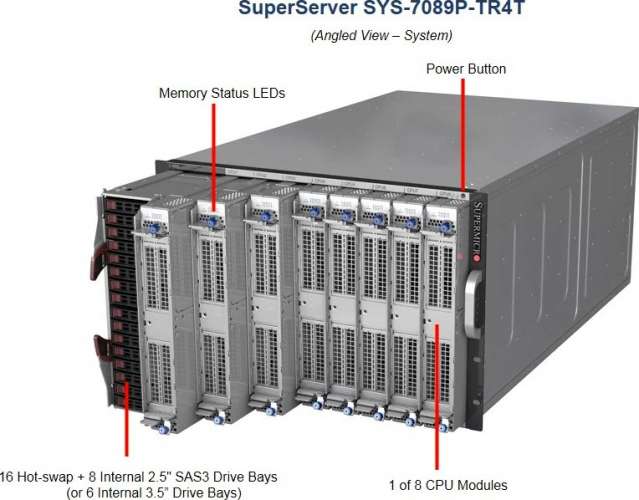
Octa Socket, up to 24TB RAM
- 7U Rack Server, 205W TDP
- Octa Intel Xeon Scalable CPU, 2nd. Gen.
- Up to 24TB RAM, DDR4-2933MHz ECC
- 23x PCIe 3.0 slots, up to 39x PCIe 3.0 slots for OEM
- 16x Hot-swap 2.5 SAS3 drive bays
- 1600W (N+2) Redundant power supplies (Titanium Level)

- 2U Rack NAS, 2 nodes
- 24x Hot-swap 2.5 drive bays
- Intel Xeon D-2142IT CPU
- Up to 512GB RAM, DDR4 ECC RDIMM
- 4x FSP+ 10GbE LAN ports
- 3x RJ-45 GbE LAN ports
- 700W Redundant power supplies

- 2U Rackmount Server, up to 350W TDP
- Dual Socket E, 4th Gen Intel Xeon Scalable Processors
- 32x DIMM slots, up to 8TB RAM DDR5-4800MHz
- 12x 3.5 hot-swap drive bays
- Up to 8x PCI-E Gen5 Expansion slots
- 2x AIOM Networking slots, 4 GPUs
- 2x 1200W redundant Power Supplies (Titanium Level)

- 2U Rackmount Server, up to 350W TDP
- Dual Socket E, 5th/4th Gen Intel Xeon Scalable Processors
- 32x DIMM slots, up to 8TB RAM DDR5-4400MHz
- 8x 2.5 hot-swap NVMe/SATA/SAS drive bays
- Up to 8x PCI-E 5.0 x8 slots — optional
- 2x AIOM Networking slots, 4 GPUs
- 2x 1200W redundant Power Supplies (Titanium Level)

- 2U Rackmount Server, 64 Cores / 350W TDP
- Single Socket E, 5th Gen Intel Xeon Scalable Processors
- 16x DIMM slots, up to 4TB RAM DDR5-5600MHz
- 4x hot-pluggable Nodes
- 6x 2.5 Inch hot-swap drive bays
- 2x PCIe Gen5 Expansion slots
- 2x 2200W redundant power supplies (Titanium Level)

- 2U Rackmount Server, up to 350W TDP
- Single Socket E2, Intel Xeon 6 Series CPU
- 16x DIMM slots, up to 4TB RAM DDR5-6400/8000MHz
- 2x 2.5 Inch NVMe/SATA/SAS hot-swap drive bays
- 2x 10GbE RJ45 LAN ports
- 7x PCI-E Gen5 Expansion Slots (4x GPUs, 2 NICs, 1 x DPU)
- 4x 2000W redundant power supplies (Titanium Level)
Do you need help?
Simply call us or use our inquiry form.
What Is Server Virtualization?
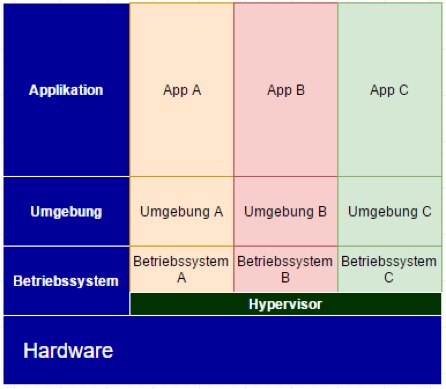
Server virtualization is used to provide systems, applications, or server resources in a virtualized form. With a “virtual server,” the system can operate in the same way as it would with a physical server.
Each virtual machine (VM) runs its own operating system, while the underlying server hardware is shared. This creates independent environments that can be configured individually to meet different requirements. Virtual machines are also referred to as logical partitions, logical domains, or kernel-based virtual machines (KVM).
What are the advantages of server virtualization?
Companies can use server virtualization in a variety of ways to leverage their resources more efficiently and save money in the long run:
- Fully utilized hardware resources
- Easy configuration
- Efficient allocation of resources
- More space and lower electricity needs
- Free choice of servers for virtualization
- New space for old applications
Server Virtualization: The Three Most Common Virtualization Approaches
To implement server virtualization effectively, several different approaches are available. These methods are often used simultaneously and combined within modern virtualization platforms. The chosen approach depends on guest OS support, available hardware features, and the specific configuration settings.
- Software Virtualization Software virtualization does not require special hardware support. Memory protection mechanisms are used to prevent conflicts caused by overlapping access. I/O requests to physical devices are intercepted and forwarded to the hardware by the host software. In this type of server virtualization, the hypervisor emulates devices by analyzing operating system code.
- Hardware Virtualization Hardware virtualization relies on specialized CPU instruction sets or I/O device features, which must be supported by the underlying hardware. Virtual machines can then use hypervisor calls to access devices directly. This increases hypervisor efficiency, as fewer resources are required for emulation.
- Paravirtualization Paravirtualization uses drivers that are specifically adapted to the hypervisor, reducing or eliminating the need for dedicated hardware support. I/O requests are sent directly to the hypervisor at a logical level, which then forwards them to the hardware. This removes the need to monitor guest operating system code and significantly improves communication efficiency between guests and the hypervisor.
Operating System–Level Server Virtualization
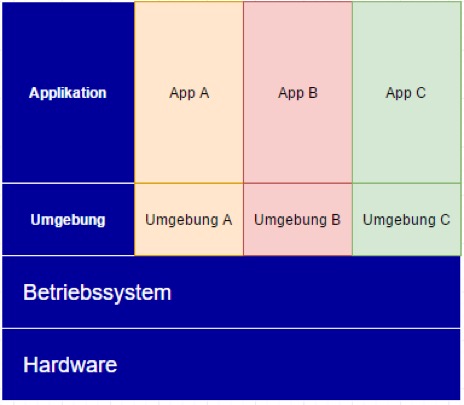
With operating system–level virtualization, only a single operating system is installed on the server. The OS then provides multiple isolated environments. These environments behave like independent operating systems, but they do not have direct access to the physical server. Applications can still be configured and operated independently, ensuring isolation and protection. In this virtualization model, all instances share the same kernel and drivers, which also means a consistent patch level across environments. Depending on the solution in use, the TCP/IP stack may be shared or configured individually.
Server Virtualization: How Virtualization Software Works
In any virtualization environment, the virtualization software plays a central role. Put simply, virtualization platforms—also known as hypervisors—abstract the physical server hardware. Selected server resources are then provided to a guest operating system as virtualized hardware within a virtual machine.
This approach allows multiple servers or clients to be consolidated on shared hardware. As a result, operating costs are reduced through improved resource utilization, simplified administration, and more efficient backup processes. Another key advantage of server virtualization is increased availability for both servers and critical services.
Server Virtualization and the Importance of Hypervisors
When it comes to the type of virtualization, a basic distinction is made between type 1 (bare-metal hypervisor) and type 2 (hosted hypervisor) virtualization concepts. While bare-metal hypervisors are based directly on the hardware and do not require a host operating system, type 2 hypervisors are software that can be installed under Windows, Linux, or MacOS X.
In addition to server virtualization, the software also enables desktop virtualization for virtual desktops or applications. Furthermore, a hyperconverged infrastructure (HCI) can be used, which combines servers, storage and networks in an integrated platform.
In practice, however, the limits of this definition are becoming increasingly blurred. For example, Microsoft Hyper-V is considered a bare-metal virtualization product, while KVM (Kernel Virtual Machine, Linux) is a hosted hypervisor.
Everything you need to know about server virtualization and much more at HAPPYWARE
If you are looking for more information on server virtualization or you have further questions, please phone or send us an email - we will be happy to help.